
Car dealerships
Dealership cleaning where the showroom meets the service bay
A dealership is two buildings in one: a showroom judged like a retail space, and a service side that handles oil, brake dust and solvents. DC Commercial Cleaning discusses glass, floors, customer lounges and service reception together, then sets an early-morning routine that finishes before the sales floor opens.
One site, two standards
Two facilities under one roof
Sales and service are one building on a lease and two different cleaning problems. On one side, polished floors, glass and a display standard closer to a jewellery counter than a workplace. On the other, a working garage with lifts, oil, brake dust and solvent handling.
The awkward part is that the same customer sees both within twenty minutes: keys handed over at service reception, a walk past the bays, then a lounge opening onto the showroom. A scope treating the site as one average building over-cleans one half and under-cleans the other. Describe both halves or call (571) 506-2402.
Under the lighting
Showroom glass and floors under display lighting
Display lighting is engineered to flatter paintwork, and it is merciless on everything else.
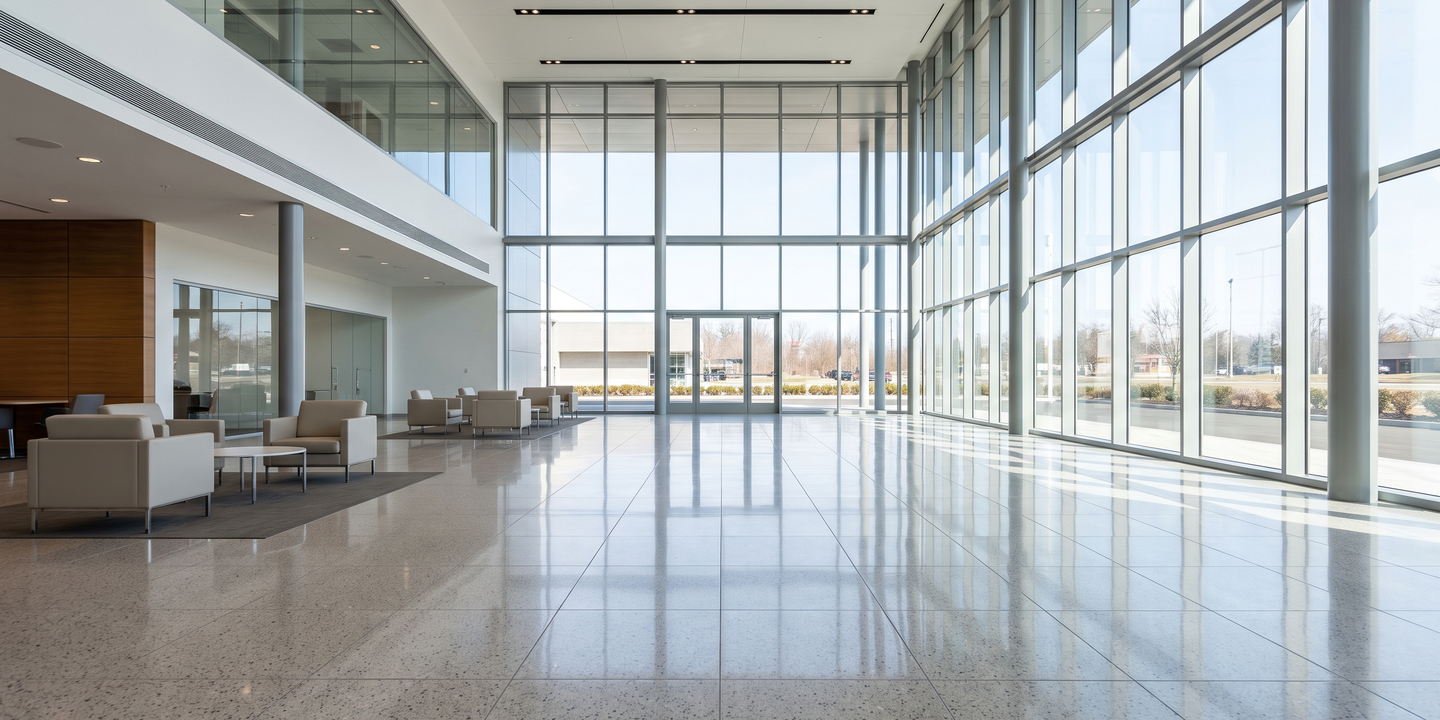
Floor-to-ceiling glazing is the defining surface here, judged from outside in daylight and from inside against spotlights. A streak invisible at eight appears the moment the sun moves onto the frontage, so the shape of the wipe matters as much as the product. Frontage window cleaning is usually a separate line from the interior routine.
Floors carry a constraint most do not: a vehicle worth six figures stands on them, and a finish that looks superb but leaves a slick patch beside a driver’s door is a hazard. Reflectivity is wanted; residue and slip risk are not, and that balance is worth agreeing early.
The transfer point
The service corridor and what it carries in
Almost everything that goes wrong on a dealership floor arrives on the soles of shoes. The route from the bays to service reception and on to the lounge carries oil film, brake dust, rubber and road grit all day, and by mid-afternoon it shows as a grey path on a pale floor.
Handling it is containment rather than cleaning harder: the corridor becomes its own zone on its own frequency, matting sits at the transition rather than the entrance alone, and the sequence runs clean-side first. Where transfer has built up over months, a one-time deep cleaning visit beats a heavier weekly routine.
Where the time is spent
Customer lounges, where the hour is actually spent
Nobody spends an hour in a showroom. They spend it waiting on a service.
The lounge is where a customer forms the impression they repeat to other people, and it takes the load: a coffee machine with a drip tray, spills on soft seating, a counter collecting sugar and milk rings, and restrooms used far more heavily than the showroom’s.
A spotless sales floor beside a tired waiting area is the commonest complaint here, and it is a frequency problem rather than an effort one. Lounges and service restrooms want a mid-day touch rather than one overnight pass, which is the reasoning behind a dedicated restroom cleaning line alongside the sales-office routine under office cleaning.
Audited on appearance
Brand presentation standards and early-morning windows
The pressure here comes from the manufacturer rather than a public inspector. Franchise standards set an explicit presentation bar for glass, floor finish, lounge and reception, and a brand visit scores it — a fixed target with the occasional short-notice deadline.
Timing is squeezed from both ends. The showroom stays lit and visible from the street long after sales close, and the service drive opens well before the sales floor, so the window is split rather than shared. Most sites settle on an early pass finishing before sales open, service side first, with a commercial cleaning scope drawing the two together.
Give both opening times
Service drive and sales floor rarely open together. The gap between them decides the sequence, the crew size and where a mid-day return is needed.
Send both timesThe boundary
What is not included: vehicles and workshop waste
Two things sit firmly outside this scope, and it is better to say so early.
Vehicles are the first. Preparation, valeting and detailing are a distinct trade with their own bays, products and staff, and DC Commercial Cleaning does not offer them — nothing here covers a vehicle inside or out.
Workshop waste is the second. Used oil, coolant, solvents, filters and parts washers run under your own disposal arrangements and stay with your technicians, as does their equipment. DC Commercial Cleaning holds no manufacturer accreditation, runs no brand-standard program and claims no automotive waste or workshop competence. Set out what your franchise audit measures and what your bays require, and the routine is built inside those limits.
Frequency and cost
What shapes a dealership quote
The two halves are costed as separate lines, because their frequencies rarely match. Glazed area drives more of the figure here than square footage alone, and lounge traffic decides whether a mid-day return is needed.
Recurring office-cleaning guide range per sq ft. Many factors apply and each price is customised for the location. Visit the pricing guide for the published guide ranges and their context.
Dealer sites along the Alexandria, VA and College Park, MD corridors are within reach on the usual terms. The showroom-versus-workshop divide has cousins across the industry pages: a retail store stakes its reputation on a doorway, while a warehouse gives the same moving-vehicle floor over to safety instead of display.
Answers for dealer principals
Car dealership cleaning FAQs
Where dealer principals usually want the boundary drawn between our work and theirs.
Do you clean the vehicles themselves?
No. Vehicle preparation, valeting and detailing are a separate trade and are not offered here. The scope is the building the vehicles stand in: glass, floors, lounges, reception, restrooms and offices.
How do you stop oil and tyre marks reaching the showroom floor?
By treating the corridor between the two sides as its own zone, cleaned on its own frequency, with matting at the transition and the sequence running clean-side first. It is a containment problem rather than a floor-finish one.
Can cleaning finish before the sales floor opens?
That is the usual arrangement, though the service drive normally opens an hour or more before sales. Tell us both opening times and the routine can be sequenced so neither side is worked around a waiting customer.
Is the service department quoted separately from the showroom?
They are commonly separate lines, because the soiling and the frequencies differ. Workshop bays themselves usually stay with your own technicians; service reception, the customer corridor and the lounge sit naturally in a cleaning scope.
Next step
Start with the glass and the lounge.
How much glazing wraps the showroom, what the floor is finished in, how busy the waiting area gets on a Saturday, and when each half of the building opens its doors. A dealership quote stops being generic at that point.
Request a quote