
Medical facilities
Medical facility cleaning built around your practice’s own rules
DC Commercial Cleaning discusses clinic and medical-office cleaning around waiting rooms, corridors, restrooms, reception and the staff areas your practice makes available. The scope follows the access rules, room restrictions and requirements you state, and works around appointment hours rather than interrupting them.
Clinical boundaries
Cleaning that respects clinical boundaries
A practice already owns its infection-control policy, its waste streams and its obligations to patients. A cleaning contractor does not take any of that over. What is on the table is the environment around it: the waiting room, reception, corridors, restrooms and whichever staff areas the practice chooses to open up, held to the same standard on an ordinary Tuesday as on the day someone is expected.
That distinction carries more weight here than in most buildings. Cleaning a corridor floor and disinfecting a treatment surface between two patients are different activities with different accountability, and the second one stays with your clinical team. Naming the line early is what keeps a scope honest, and it is the first thing worth raising when you start a cleaning discussion. Clinics sit alongside the other sectors on the industries list, but this is the one where the boundary is written before the task list.
Access boundaries
Where a contractor works, and where it does not
Four things a practice settles before a first visit, in the order they usually come up.
- List the rooms that are open.
Waiting areas, reception, corridors, restrooms, break rooms and any room the practice specifically includes. - Name the rooms that are closed.
Treatment rooms, records storage and drug storage stay off the route until a clinician says otherwise, and a room can be withdrawn at an hour’s notice. - Separate the waste streams.
General waste is collected from the containers you identify. Regulated medical waste, sharps containers and clinical bags are worked around and never moved or emptied. - Put the boundary in writing.
A rule that lives in one cleaner’s memory disappears the week that cleaner changes. A short written list travels with the visit instead.
Appointment hours
Working around appointment hours
Clinics run on an appointment book, not a shift pattern, and that usually leaves two workable slots: early morning before the first patient arrives, or evening once the last one has gone, with a practice manager or clinical lead present or an agreed lock-up in place. Neither slot is generous, and both move when the schedule runs late.
Access is frequently room by room rather than floor by floor. A room held for a delayed appointment, or a clinician catching up on notes, is simply unavailable that evening, and the visit has to absorb it without leaving the corridor half finished. For a practice open five or six days a week, a recurring programme through janitorial services is usually the right frame, while a multi-use building with administrative suites attached is often better discussed as commercial cleaning.
The judged space
Reception, waiting areas and the first impression a patient forms
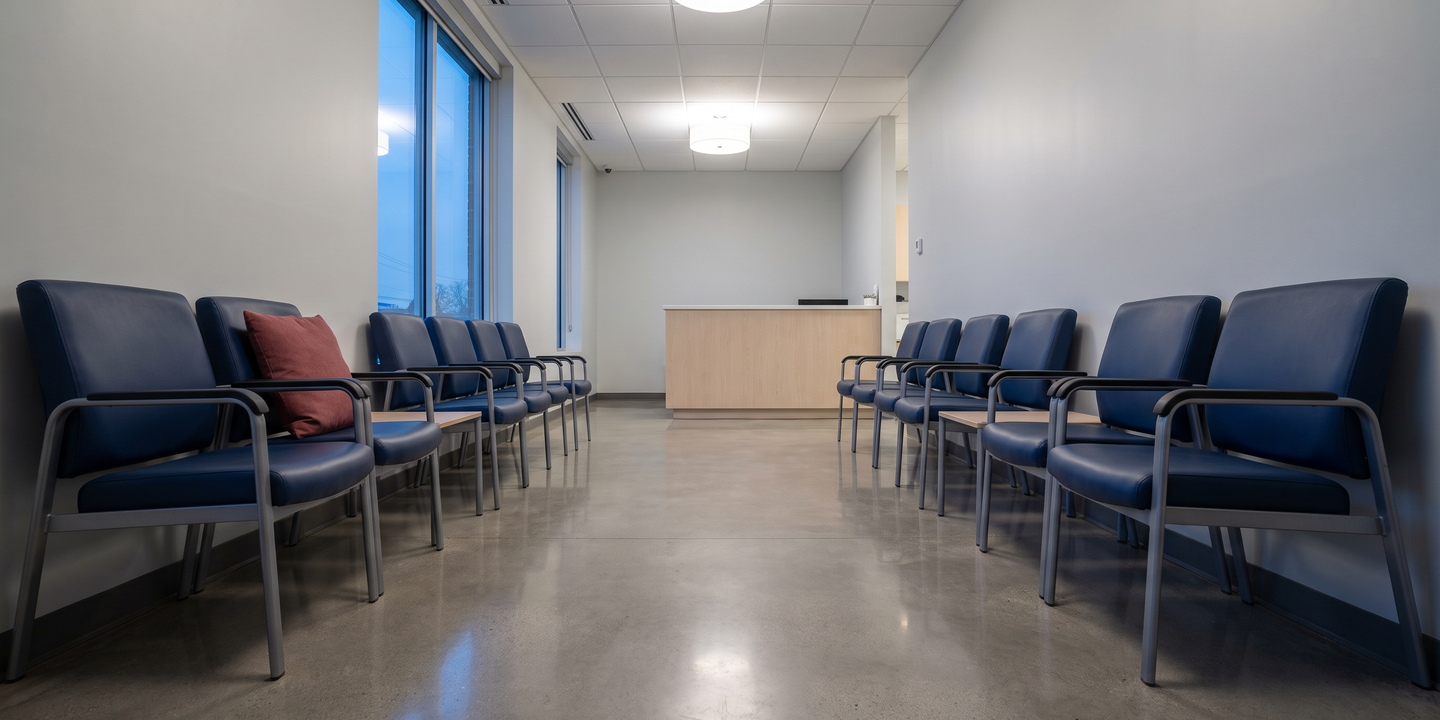
Every patient sees the waiting room before they see a clinician, and they sit in it long enough to notice. Wipeable seating, reception counters, door furniture, glass partitions and magazine tables take continuous contact from opening to close, and a room that has turned over forty people since Monday shows it by Thursday afternoon. Turnover, not square footage, is what sets the cadence.
Restrooms in a clinic carry heavier use than their size suggests, partly because patients are often asked to use them as part of an appointment; a practice that wants that scope written out on its own can look at restroom cleaning. The corridor between reception and the treatment rooms is the piece most often skipped, because it belongs to nobody in particular, and it is the route every patient walks twice.
Before a quote
Requirements your practice should state before a quote
A useful brief is short: clinic hours, the open and closed room lists, any products you will not accept in the building, the access and lock-up arrangement, and anything your practice is held to that should be considered in the scope. DC Commercial Cleaning does not claim healthcare certifications, infection-control programs or clinical protocols. Infection control belongs to your clinicians; tell us what patient safety requires of the rooms we do enter, and the scope is written around it.
Cost follows floor area, frequency, restroom count and how access works, not the word “medical”. Practices in Bethesda and Silver Spring ask about this as often as those in the District.
Recurring office-cleaning guide range per sq ft. Many factors apply and each price is customised for the location. Visit the pricing guide for the published guide ranges and their context.
A practice with a large administrative wing may also want the workplace angle covered on the offices page, and a group running an on-site childcare room will find a comparable access rule, set for different reasons, on the daycares page.
What to have ready
Clinic hours, the room lists, product restrictions and who holds the keys. Four answers are enough to begin.
Start the scope discussionAnswers for practice managers
Medical facility cleaning FAQs
What clinics ask before a first visit is arranged.
Do you clean treatment rooms and clinical areas?
Only where a practice grants access and states what may be touched. Many practices keep treatment rooms with their own clinical staff and hand a contractor the waiting room, reception, corridors, restrooms and staff areas instead.
Does DC Commercial Cleaning handle medical or biohazard waste?
No. Regulated medical waste, sharps containers and clinical bags stay with the practice and its licensed disposal arrangement. General waste is emptied from the containers you identify, and anything in a clinical stream is left where it is.
Can cleaning be scheduled around patient appointments?
That is the usual pattern. Most clinics prefer a slot before the first appointment or after the last patient leaves. Share your clinic hours and lock-up arrangement so the routine is built around the appointment book rather than through it.
What should a practice tell you about restricted rooms?
Name the rooms that are out of bounds, the rooms that need a staff member present, and any equipment or paperwork nobody should touch. A written boundary is worth more than a verbal one because it survives a change of cleaner.
Do you claim healthcare cleaning certifications?
No. DC Commercial Cleaning does not claim healthcare accreditation, infection-control credentials or terminal-clean capability. Cleaning a corridor is not disinfecting a treatment surface, and we do not present it as such. Tell us what your patient-safety policy expects of the areas we cover, or call (571) 506-2402 to talk it through.
Next step
Tell us where the boundary sits.
Send the clinic hours, the rooms that are open, the rooms that are not, and any product restrictions. That is enough to begin a scope discussion for the practice.
Request a quote