Call (571) 506-2402Washington, DC · Arlington · Alexandria · Bethesda · Silver Spring · College Park

Restaurants

Restaurant cleaning that fits between last service and first prep

DC Commercial Cleaning discusses restaurant cleaning around the closing routine: dining rooms, restrooms, service stations, entrances and back-of-house routes. The conversation covers the grease-prone surfaces, floor types and inspection priorities your operation is held to, then sets a schedule that fits between the last table and the first prep shift.

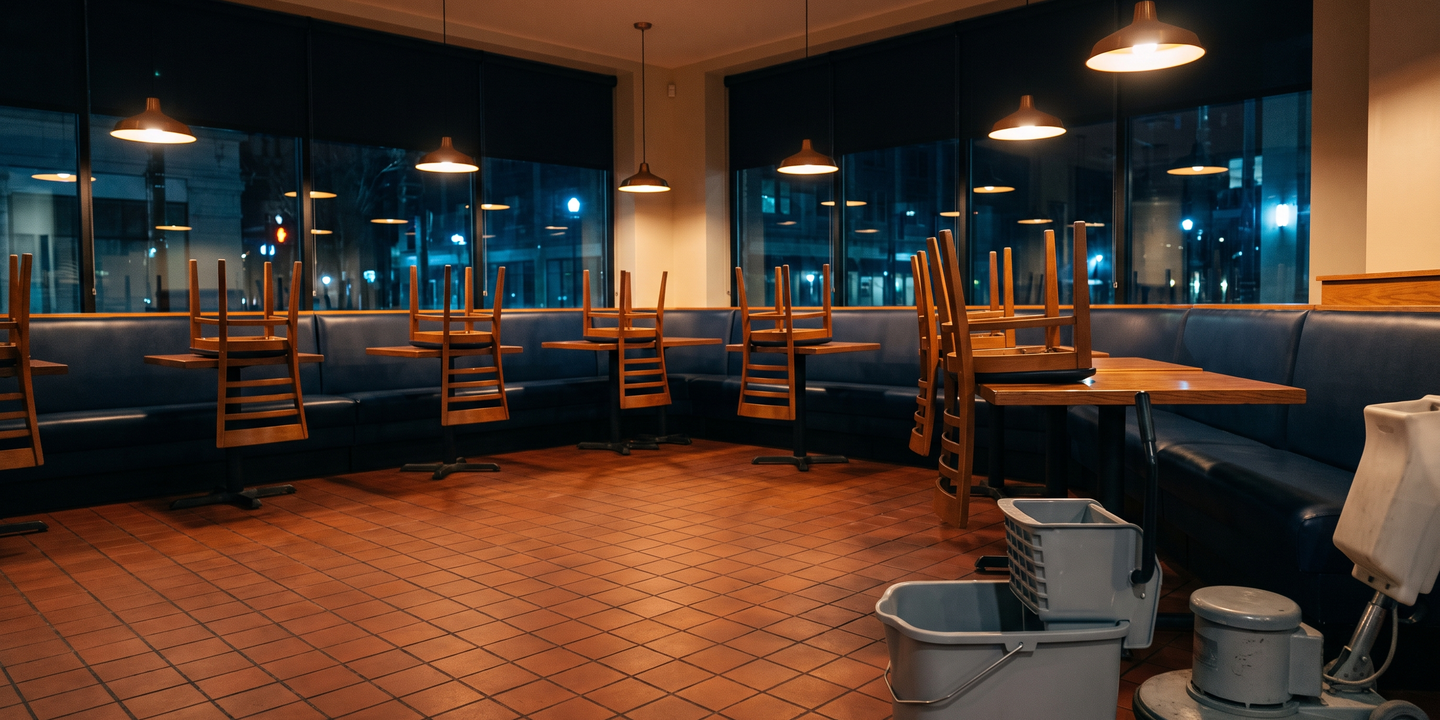
An empty restaurant dining room at night with chairs upright and floor cleaning equipment at the edge of the room.

After the last cover

Cleaning around the closing routine

The closing routine decides most of what a cleaning visit can achieve. Chairs come up, the line is broken down, mats are lifted, and the last table leaves when it leaves. A scope written against a fixed clock collides with that sequence every Friday, so the useful version is written against the sequence itself: what the closing team finishes, what it hands over, and what is still standing when a crew arrives.

That handover is worth agreeing in writing. A closing manager locking up at eleven and a crew arriving at midnight need the same understanding of which stations are broken down, which mats have been pulled and where keys and alarm codes sit. Nightly cleaning is the usual shape for that window; start the conversation with those two times.

Two audiences, one day

Front of house and back of house are judged separately

The same evening produces two verdicts, reached by different people looking at different rooms.

What a guest scores

A guest judges the dining room, the entrance and the restroom, and the standard is visual and immediate. A marked banquette, a sticky rail or a restroom already failing at eight on a Friday reaches a review long before anyone thinks about the kitchen.

What an inspector looks at

An unannounced health inspection goes where nobody looks: floor-wall junctions, under and behind fixed equipment, and grease sitting on surfaces. A dining room can be immaculate while the score is being decided six inches off the floor behind the line.

Four to six hours, sometimes less

The window between last service and first prep

Between the last cover and the first prep shift there is often a four-to-six hour gap, and on a weekend it is shorter. Some kitchens never fully close. A plan has to say what happens in a normal week and what happens when service runs long, because a visit that overruns into prep costs a kitchen more than a missed visit would.

  1. Fix the two times that matter.
    The realistic hour the last cover leaves and the hour the first prep shift arrives, not the advertised closing time.
  2. Split the site by access.
    Dining room, restrooms and entrance are usually open to a crew; the line and prep areas frequently are not.
  3. Decide what moves.
    Name what may be lifted, slid or wiped around, and what stays exactly where the kitchen left it.
  4. Agree the overrun rule.
    Say in advance what gets dropped first when service runs late, so the decision is not being made at one in the morning.

Work that will never fit inside a nightly window, from a seasonal reset to a post-refit clean, is a separate one-time deep cleaning conversation rather than something to squeeze into the gap.

Where grease actually travels

Floors, drains and the surfaces that hold grease

Grease does not stay in the kitchen. It travels on shoes and castors through the pass, along the back-of-house route and out into the dining-room floor and the entry matting, where it holds dirt and turns quarry tile greyer week by week. The answer is coverage and sequence: the transfer route gets cleaned as a route, not as two rooms that happen to share a door.

Quarry tile and sealed concrete with floor drains behave differently from the vinyl and rubber matting beside them, and the junction where floor meets wall is where build-up settles. Drains and their surrounds need naming in the scope or they are skipped, because an open floor looks finished long before its edges are. Upholstered dining seating and high-touch door furniture belong on the same list for the opposite reason: they are what a guest actually touches.

Scope before price

What shapes a restaurant cleaning quote

Covers per night, kitchen size against dining size, floor type, restroom count and the length of the window all move the work involved. So does the honest answer to one question: how much of the back-of-house is in scope and how much stays with the kitchen team. A restaurant scope that leaves that vague is the one renegotiated in month two.

$0.03–$0.05

Recurring office-cleaning guide range per sq ft. Many factors apply and each price is customised for the location. Visit the pricing guide for the published guide ranges and their context.

Hood and duct cleaning is a separate licensed trade and sits outside this scope, as does pest control. DC Commercial Cleaning does not claim food-safety certifications, inspection outcomes or specialised protocols. Tell us what your last inspection flagged and which areas your kitchen team already owns, and both can be built into the scope. A site that also runs a bar or an event space may be better framed through commercial cleaning, and restaurant work is discussed across the service markets, including Washington, DC and Arlington, VA. Sectors with their own version of the same evening sit on the retail cleaning and gym cleaning pages, and the full set is on the industries index.

Bring three things to the call

Your realistic closing time, your first prep time, and where the line sits between kitchen staff and a contractor.

Discuss a restaurant scope

Answers for operators and closing managers

Restaurant cleaning FAQs

These cover the window, the boundary with kitchen staff and what sits outside the scope.

Can restaurant cleaning happen after we close for the night?

That is the usual window. Tell us the realistic time the last cover leaves, when the closing team locks up and when the first prep shift arrives, and the visit can be placed inside that gap. Nightly cleaning is the service page for it.

Do you clean kitchen hoods and grease ducts?

No. Hood and duct cleaning is a separate licensed trade and sits outside this scope. The walls, floors and surrounding surfaces around the cooking line can be discussed as part of the recurring plan.

Who is responsible for food-contact surfaces and prep stations?

Your kitchen team. Prep tables, cutting surfaces, cooking equipment and anything food touches stay with staff, so the written scope should name that boundary before the first visit rather than after it.

How often should restaurant restrooms be cleaned during service?

Most operators run in-service checks with their own staff and treat a contractor visit as the overnight reset, because a restroom cleaned at 2am is already carrying a Friday night by eight. Restroom cleaning sets out a focused scope.

Next step

Send us your closing time and your first prep time.

With the window, the floor types and the line between kitchen staff and contractor, a restaurant scope can be drafted properly instead of guessed at.

Request a quote