
Warehouses and distribution
Warehouse cleaning around live racking and moving traffic
DC Commercial Cleaning discusses warehouse cleaning around a floor that is still in use: sealed concrete under forklift traffic, racking aisles, dock doors, walkways and the break-room block. The scope is set zone by zone, around shift patterns and the site induction your operation requires before anyone starts.
Live operations
Cleaning a floor that never stops moving
Most commercial buildings empty out and are then cleaned. A distribution building often has no such moment: inbound unloads on one shift, picking runs through the next, and the only genuine pause may be a Sunday or a shutdown booked months earlier.
That changes the unit of work. Instead of one pass across the site, the scope is written zone by zone: this block of aisles tonight, the dock apron on Thursday, the mezzanine while the reach truck works the far end. Zones move when the operation moves. Send the shift pattern or call (571) 506-2402.
Floor care at scale
Sealed concrete, scrubbers and forklift traffic
Forty thousand square feet of sealed concrete is not a mopping job.
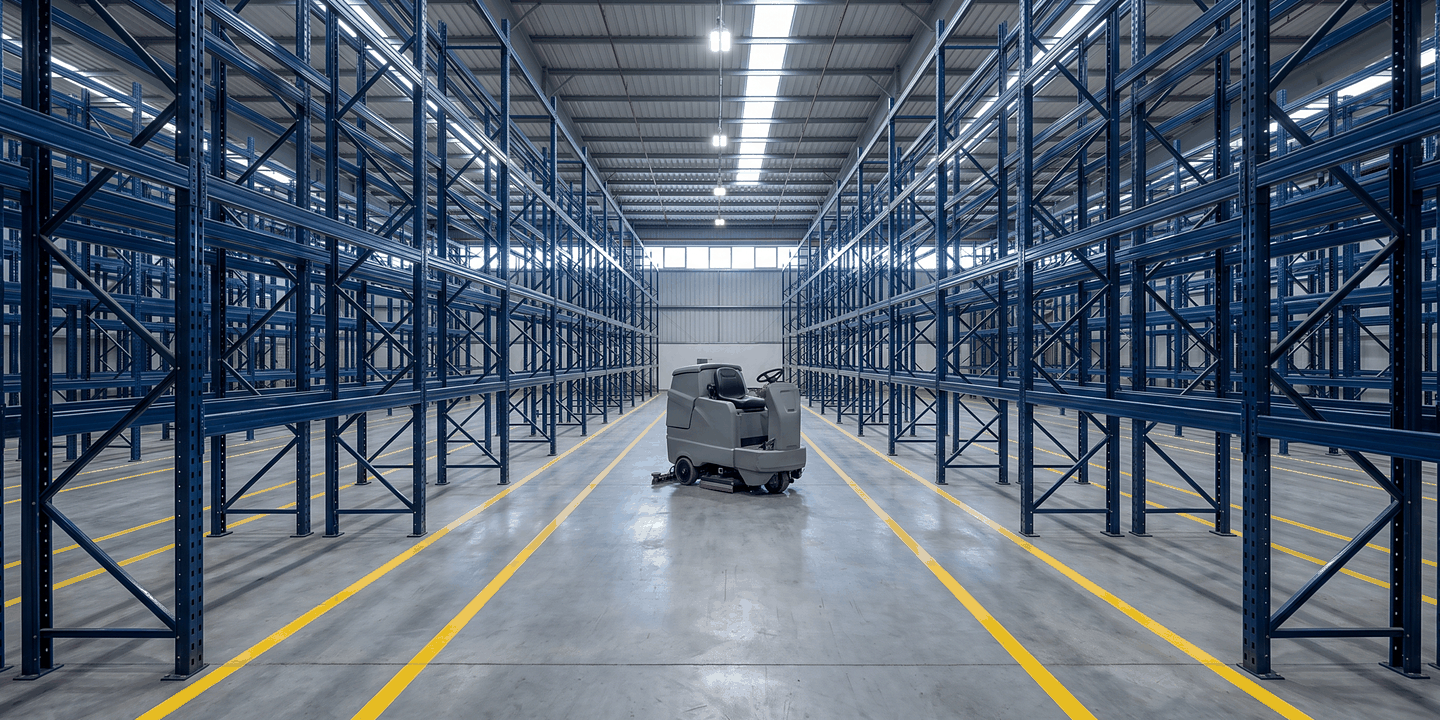
The floor is worked with walk-behind or ride-on scrubber-dryers sized to the aisle width, with a sweep ahead of them for shrink wrap, banding and pallet splinters. Domestic-scale equipment on that surface produces a visible line of clean and very little else, which is the commonest reason a warehouse contract quietly stops delivering.
Forklift traffic then adds something dirt does not. Rubber transfer builds in the turning circles, at aisle ends and around the dock apron, and it wants the right pad and chemistry rather than more water. The areas never touched are those under live racking, so the scope should say what happens where a pallet has stood for a year, and whether a one-time deep cleaning visit resets it.
Safety sets the method
Aisles, walkways and access that safety rules dictate
On this floor a person and a two-tonne truck share one surface, and the rules that follow decide how cleaning is allowed to happen. Marked walkways stay visible, aisles stay clear, exits stay unobstructed, and a spill is handled as an incident rather than an item on a checklist.
The failure mode is a crew that becomes the hazard: a machine parked in a traffic route, a cable across a walkway, someone stepping into an aisle a driver did not expect. Traffic separation, high-visibility clothing and permission before entering a live aisle answer most of it. DC Commercial Cleaning does not claim OSHA programs, industrial hygiene, hazardous spill response or safety accreditation. Traffic management, working at height and racking inspection stay with your team — set out those controls and the routine gets planned inside them.
Above head height
Dust on racking, ledges and stock
Dust in a warehouse settles upward long before anybody sees it on the floor.
Upright frames, beam ledges, pipework and the tops of racking collect airborne dust from traffic, cardboard and packaging, and hold it until something disturbs it. Blowing it down over live stock moves the problem onto the pallets instead of out of the building, so the sequence matters more than the method.
High-level work belongs in an aisle that has been de-stocked, and it comes before the floor rather than after it. Reachable ledges and the accessible faces of racking are the honest scope; beam-level work and racking inspection are controlled activities your site owns. A commercial cleaning discussion is where that boundary gets written down.
Attached, but unrelated
The office and break-room block is a different job
Bolted to nearly every warehouse is a small building doing entirely different work: a transport office, supervisors’ desks, a break room, lockers and restrooms sized for a shift changeover rather than a working day. It is cleaned like an office, using none of the equipment running next door.
It is also the part that gets neglected, because attention follows the floor an auditor walks. Break rooms used at six, at two and at ten never get a natural gap, and restrooms take a day’s load in the minutes around a shift change — which is why restroom cleaning and a recurring janitorial services line are specified separately for that block.
Measure the two parts separately
Give the warehouse floor area and the office and welfare area as two figures. They are cleaned at different frequencies with different equipment, and one combined number hides both.
Send both figuresGetting on site
Shift patterns, inductions and getting on site
Access here is rarely a key. It is an induction, a named contact on the running shift, a sign-in point and sometimes a permit. Arranging that before the first visit is what stops a crew standing at a gate at ten at night.
Pricing a building like this starts from the machine rather than the mop. Aisle width decides what equipment fits down it, the seal decides the pad and chemistry, and the number of zones decides how many attendances cover the site once.
Recurring office-cleaning guide range per sq ft. Many factors apply and each price is customised for the location. Visit the pricing guide for the published guide ranges and their context.
Storage and distribution buildings sit mostly outside the city centre, and those in College Park, MD and Silver Spring, MD are reachable on the usual terms. The welfare block is really an office problem, and the moving-vehicle floor recurs at a dealership with appearance replacing safety as the driver; the rest sit on the industry pages.
Answers for site managers
Warehouse cleaning FAQs
Four things a site manager usually wants settled before a machine comes through the gate.
Can warehouse floors be cleaned while operations continue?
Usually, but zone by zone rather than all at once. A block of aisles is released, cleaned and handed back while work carries on elsewhere. The alternative is a shift gap or a planned shutdown, which is where one-time deep cleaning work is best placed.
What equipment is used on a large concrete warehouse floor?
Walk-behind or ride-on scrubber-dryers sized to the aisle width, with a sweep ahead of them for loose debris. Mops and domestic vacuums achieve very little across tens of thousands of square feet, and the pad and chemistry are matched to the floor’s seal.
Does your team need a site induction before starting?
Yes, and it works best before the first visit rather than at the gate. Traffic routes, exclusion zones, alarm points and any permit rules are covered there, and anyone attending later needs the same briefing.
Are warehouse offices and break rooms quoted separately?
They are usually their own line, because the work is different. The floor is measured and machine-cleaned; the office and welfare block runs on office frequencies with restrooms, kitchens and desks, and needs its own area figure.
Next step
Start with a floor plan and a shift pattern.
Mark the zones on the plan, say which of them go quiet and when, and name the induction anyone entering the building has to complete. A zone-by-zone routine can be drafted from that much.
Request a quote