
Salons and barbershops
Salon cleaning between the last appointment and the first
DC Commercial Cleaning discusses salon cleaning around styling stations, wash basins, mirrors, reception and restrooms. The scope accounts for hair reaching every floor edge, product residue on surfaces, and an appointment book that leaves a narrow evening window, then sets a routine the salon can rely on.
Booked to the last slot
Cleaning around the appointment book
A salon’s cleaning window is decided by the appointment book, not by the hours on the door. A color service booked at six runs past eight. A barbershop keeps cutting while anyone is still sitting in the waiting row. The published closing time is the earliest the room could be free, not the hour it usually is.
That makes the diary the first useful thing to discuss: which nights run long, who locks up, and whether a key-holder arrangement beats waiting for the last stylist to finish. Salons trading six or seven days often want a short pass after closing with one longer reset behind it. Send the shape of your week or call (571) 506-2402.
Where it collects
Hair reaches every edge, not just the open floor
Cut hair travels a long way from the chair it fell from.
It drifts to the edge of the floor, collects along baseboards, wraps around chair castors and hydraulic bases, and works into the gap where a mat meets the floor. A crew that sweeps between the stations and leaves at nine has cleaned the part nobody was going to complain about.
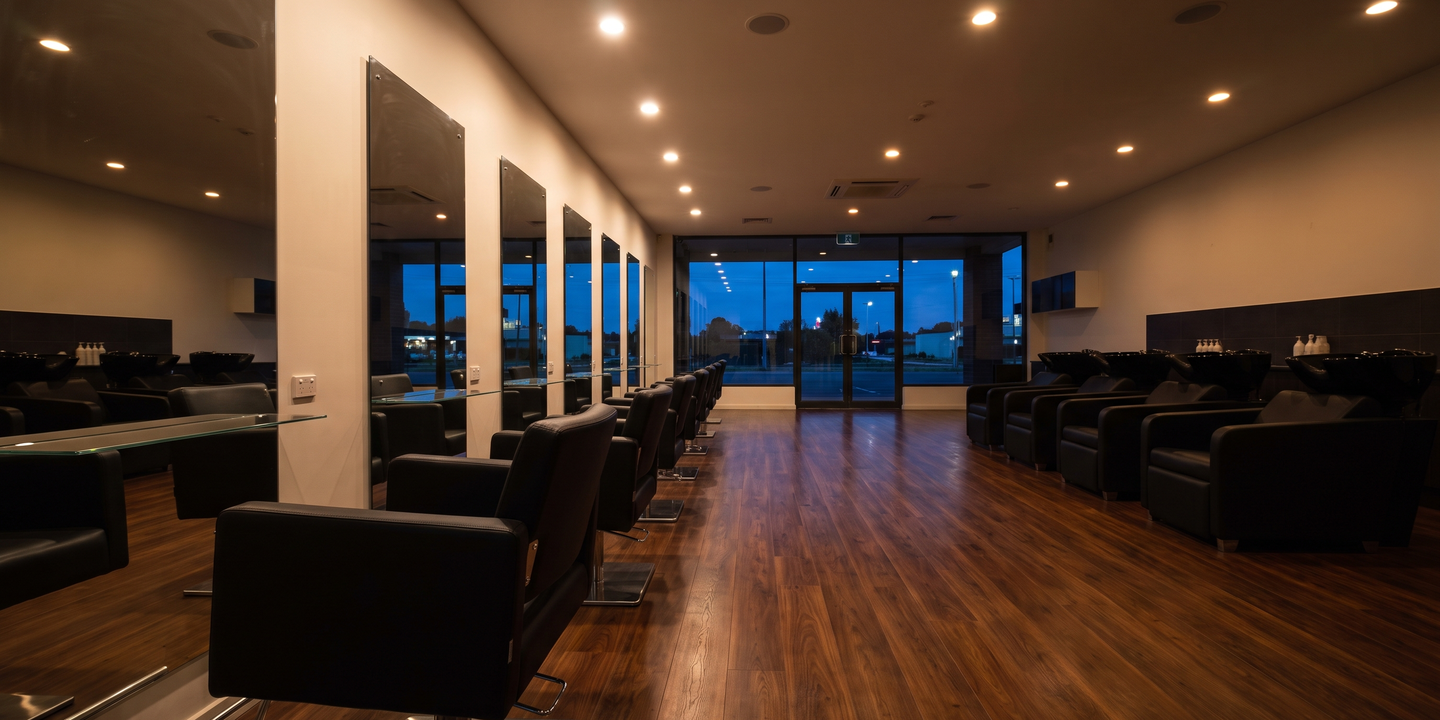
So a salon scope is worth writing at edge level: under and behind every chair, the station footprints, the strip along the mirror wall, the reception mat and the threshold at the door. Product and color residue lands on the same floor, which is why a dry sweep alone stops holding after a few weeks. A one-time deep cleaning visit is the usual way to reset it.
Inspected at close range
Basins, mirrors and the surfaces clients look at closely
A client sits still for forty minutes with nothing to look at but a mirror and the counter beneath it. That is closer inspection than almost any other commercial room receives. Water spots on the glass, hairspray film on the frame, a smear where a brush was set down: all of it is read at arm’s length, under task lighting chosen to show detail.
Basins carry the other half of it. The surround holds product film and color splash, the bowl marks quickly, and the trap is a recurring job the salon usually has an opinion about, so agree who clears it and how often. Front glass belongs in the same conversation, and a separate window cleaning scope can cover the shopfront.
Describe the mirror wall
Say how many stations there are, whether the mirrors are framed or full panels, and which counters carry product. It changes the cloths and the time on site, not only the price.
Tell us about your stationsThe boundary
What stays with licensed staff
Licensing draws a line through the middle of a salon, and it is worth stating.
District cosmetology licensing sets sanitation expectations, and they sit with the owner and the licensed staff who hold them. Tool and implement disinfection, the storage of clean implements, the color-mixing area and anything applied to a client all stay on that side of the line.
What a contractor is asked for is the shared fabric: floors, basin surrounds, mirrors, reception, restrooms, waste removal and the condition of the room between clients, which is the ground a recurring janitorial services plan covers. Chemical storage and the ventilation of color and nail services remain the salon’s own obligation. To be plain about it: DC Commercial Cleaning holds no cosmetology credential, works to no board-defined sanitation standard, and disinfects no implements. Those belong to your licence and the people who hold it. What helps is knowing which sanitation rules your salon works to and which surfaces they touch, because that shapes where a contractor's routine stops.
Frequency and cost
Evening windows and the weekly reset day
Most salons settle on one of two shapes. A short pass after the last client on the nights that need it, focused on floors, basins, mirrors, restrooms and waste, which is the nightly cleaning conversation. Or a lighter routine through the week with one deeper visit on the closed day, when chairs can be moved and a floor can be left to dry without anyone walking over it.
Cost follows that shape rather than the size of the sign outside. Floor area, the number of stations, how many nights are covered and whether restrooms are included all change the work involved.
Recurring office-cleaning guide range per sq ft. Many factors apply and each price is customised for the location. Visit the pricing guide for the published guide ranges and their context.
Salon work is discussed across the same service markets as the rest of the business, including Arlington, VA and Alexandria, VA. Other appearance-led spaces sit beside it on the industry pages: a retail floor is judged in the doorway, and a gym is judged on its changing rooms.
Answers for salon owners
Salon cleaning FAQs
Questions that come up when a salon plans a routine. The scope itself is confirmed with the salon.
Can you clean after our last appointment rather than before opening?
An evening window after the last client is the usual arrangement. Tell us which nights normally run late and who locks up, so the arrival time and the key handover are agreed before the first visit.
Do you disinfect combs, shears and styling tools?
No. Tool and implement disinfection stays with your licensed staff, and DC Commercial Cleaning claims no cosmetology sanitation standard. The contractor scope covers floors, basin surrounds, mirrors, reception, restrooms and waste in the shared areas.
How do you deal with hair that collects around chairs and edges?
By naming the edges in the scope rather than the open floor. Under and behind the chairs, the castors and hydraulic bases, the strip along the mirror wall, the baseboards and the reception mat are listed individually.
Can a salon book a deeper clean on its closed day?
A closed day suits work that needs chairs moved and floors left to dry properly. Discuss it as a one-time deep cleaning visit, or as a periodic reset built into a recurring routine.
Next step
Tell us how the week actually runs.
Send the nights that run late, the number of stations, whether basins and restrooms are in scope, and the day the salon closes. That is enough to begin a tailored discussion.
Request a quote